|
You already know people like this:
— The ones who walk into a room where they don’t know a
soul, and own it inside ten minutes.
— The ones who get the call that would flatten anybody, and
by lunch they’re already working on the problem.
— The ones who hear "no" a hundred times and never once
doubt what they’re worth.
— The ones who like and trust themselves without needing
anyone's approval.
— The ones who are grateful for what little they have, while
they go hard after everything they want.
None
of them were born that way.
What they’ve developed is a set of positive, empowering
beliefs, expectations and automatic responses they no longer
have to think about. Because these patterns now run
on their own, all day, every day.
Here’s the part nobody tells you.
Those same mental patterns that power the best of the best
can be built into you.
That’s what Think Right Now programs do.
Each program is focused on one area of your life —
confidence, self-esteem, thinking bigger, and more. It
releases more than a thousand disempowering,
failure-producing thoughts, beliefs, attitudes and emotional
patterns that make positive habits impossible. They're sorted into
the nine to thirteen pillars that govern that entire area of
your life.
Nothing gets missed. Nothing gets left behind to pull you
backwards six months from now.
And in their place, it installs the exact thinking the very
best are already running on, every day, without effort.
All of this happens as you’re living your daily life. Let
your program play while you work, drive, exercise, clean the
house or fall asleep, and the new thinking goes in while
your attention is somewhere else entirely.
Now imagine a stronger version of you as your everyday self:
— You walk into the interview, the sales call, the difficult
conversation, or the crowded room and think, feel, and
respond the way you want, automatically.
— The goal you’ve only dreamed about for years becomes the
one you’re now going after.
— Ideas you once would have talked yourself out of turn into
income, opportunities, and a better life for your family.
— And you enjoy the life you’re building now, not someday
after the next goal.
You
feel yourself changing week by week.
Hard decisions become easy. Things you used to put off for
weeks now get done in a snap. A room full of strangers
becomes a room full of friends. You like the person making
your big life choices.
You don’t struggle with any of it, because it’s simply
who you are now.
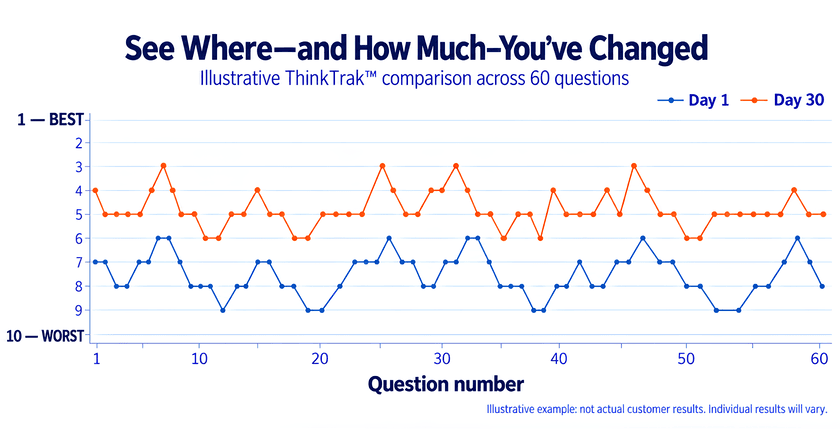
And you'll see it in black and white. Every program includes
its own ThinkTrak™ assessment. Take it on day one, take it
again on day 30, and see exactly how far you've come.
The person you've become is worth more than any one thing you’re chasing. Money
comes and goes. Jobs come and go. Relationships can end.
But you can come back from any of it, because who you become
can never be taken away.
Your current limiting beliefs and habits no longer get to
decide how much you can accomplish or how good your life can
be.
The person you’re becoming does.
Start Thinking And Acting Like The Very Best At What You
Want To Do—Free
Choose the area of your life you most
want to change.
You’ll get that program’s complete Volume 1 and everything
you need to start using it, free.
These aren’t samples, demos, or trials that bill you
later. They're complete 30-plus-minute volumes, identical to
Volume 1 in the Complete Programs, and they're yours to
keep.
Here's what your free Foundations do for you:
•
Shows you what’s really holding you back.
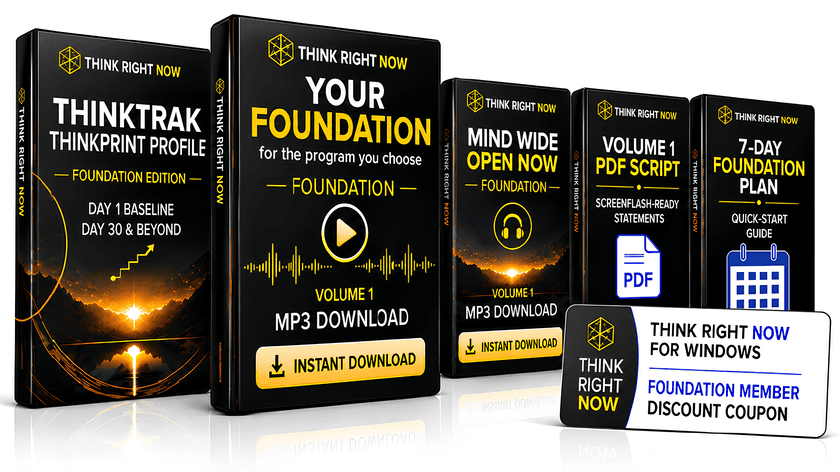
You get a separate printable ThinkPrint for every
program you choose, built around exactly what that program
is designed to change. Each reveals the specific beliefs,
thoughts, and reactions working against the change you want,
how strongly each one is present, and where you’re already
strong. Only you see your answers since you print it and
fill it out privately.
•
Starts changing those patterns the first time you listen.
Each
Volume 1 goes to work on those patterns right away, clearing
the thoughts that hold you back and building the ones that
move you forward. Change begins and continues every time you use it.
•
Opens your mind to everything ahead.
Mind Wide Open Now, Volume 1, prepares you for
change. It builds the belief that you learn quickly and it has you looking forward to every
positive change coming your way, however big, with
excitement instead of fear. It primes you to get more from
your Foundation program and from every Think Right Now
program after it.
•
Tells you exactly what to do.
Your Quick-Start Guides and 7-Day Foundation Plans show
you how to get the fastest, strongest results from your very
first week.
•
Puts the statements in your hands.
The printable Volume 1 script for each title lets you read the
statements, mark the ones that hit you hardest, and say them
in your own voice.
•
Goes wherever you go.
Ad-free listening, online or offline: in the car, at the
gym, at your desk, or as you fall asleep.
•
Turns screen time into change time.
Your Foundation Member discount on Think Right Now for
Windows lets you flash your program’s statements
across your screen while you work.

At Day 30, take your ThinkTrak
assessment again and see how much has changed.
Most companies give away a sample to see whether you like
it. Think Right Now gives you a complete volume and the
tools to start changing your life with it. Once you feel the
change begin, the only question left is how far the Complete
Program can take you.
|
|
|
 |
|
No Credit Card Required
Which change would mean the most to you? |
Finally
See What's Been Holding You Back
Confidence isn’t one thing.
Neither is calm, self-esteem, motivation, or any other
area of life you want to change. Each is built from
hundreds of individual beliefs, habitual thoughts,
expectations, and emotional reactions. Some are working
for you. Others have been quietly working against you
for years.
You can’t see them directly, but you live with their
results every day. They decide whether you act or hold
back, speak up or stay quiet, go after the opportunity
or talk yourself out of it, keep going or quit when it
gets hard.
Many started with something small: a comment someone
made years ago, a rejection, an embarrassing moment, or
a thought repeated until it felt true. Then they fed
themselves.
A thought shapes how you feel.
How you feel
shapes what you do.
What you do shapes the result you
get.
And that result seems to prove the original thought
was right.
Around and around it goes, until it runs automatically.
Everyone has patterns like these.
The real question is
which of yours are moving your life forward, which are
keeping you stuck, and which are pulling you backward.
ThinkTrak™
Makes the Invisible Visible
 Every
Think Right Now program comes with its own ThinkTrak
assessment, built around the exact beliefs, thoughts,
and reactions that program is designed to change. You
answer questions about how you actually think, feel, and
respond. Every
Think Right Now program comes with its own ThinkTrak
assessment, built around the exact beliefs, thoughts,
and reactions that program is designed to change. You
answer questions about how you actually think, feel, and
respond.
Your answers become your ThinkPrint: a
detailed picture of who you are right now in that area
of your life.
The questions themselves are
eye-opening. As you answer, you’ll recognize patterns
you’ve lived with for years but never put into words.
Then your ThinkPrint lays them out.
Instead of a
vague problem like “my confidence” or “my
anxiety,” you see the specific patterns underneath
it: which ones are empowering you, which are getting in
your way, and how strongly each one is present. You’ll
also see where you’re already stronger than you
realized.
And your answers never leave your house. You
print it, fill it in by hand, and score it yourself.
There's no account and nothing to upload, so you can be
completely honest — which is the only way the picture
comes out accurate.
Think about what that’s worth. Many of the tests you
took in school mostly measured what you studied and
tried to memorize for a week or two. And the score
didn't predict anything meaningful about your life.
But your ThinkPrint scores mean something to you...
ThinkTrak measures the beliefs and reactions
that shape your decisions, relationships, income, and
future every single day.
Once you know what’s causing
the problem, it’s no longer one big, undefined struggle.
It’s specific, and your Think Right Now programs are built
to change exactly those patterns.
Feel the Change. Then
Measure It.
Change begins the moment you start using your program. You think
differently, react differently, and more easily do things that used
to be hard.
You won’t need a test to tell you that.
But think about losing weight, for example...
You already know you’re
making progress: you have more energy, your clothes fit
better, and people notice. Then you step on the scale,
take your measurements, compare them with where you
started, and see exactly how far you’ve come.
ThinkTrak gives you that same proof for changes
no scale can measure. At Day 30, take the assessment
again and compare your new ThinkPrint with your
Day-1 ThinkPrint. You’ll see how much stronger the
beliefs that support you have become, how much weaker
the old limitations are, and how differently you now
respond to the situations that used to stop you.
That matters more than you might think. Once a new way
of thinking becomes natural, it’s surprisingly easy to
forget how hard the old way felt. Your Day-1 ThinkPrint
preserves exactly where you started.
And once you’ve proven to yourself that you can
change, the question is no longer “Can I?” It becomes
“How far can I go?”
|
|
|
|
|
No Credit Card Required
Take your ThinkTrak assessment and start
listening. |
|
When Knowing What to Do
Isn't Enough |
Imagine a woman who has driven safely
almost every day for 25 years. Cities, highways, heavy
traffic, night driving, bad weather.
 Then
she’s in a serious accident. Then
she’s in a serious accident.
Now, the moment she gets behind the wheel, her heart pounds
and her hands clamp onto the steering wheel. Most days she
can’t bring herself to leave the driveway. Little by little,
she starts arranging her life around not driving.
She doesn’t need another driving lesson. She knows exactly
what to do. What stops her is what now happens
automatically, before she has time to think.
You may never have been in an accident. But in other
situations, almost everyone has had reactions like hers,
ones that fire before reason can catch up...
The freeze before the phone call.
The knot in your stomach before you speak up.
The voice that says don’t the instant an opportunity
appears.
Information can’t change a reaction like that. Because it was learned
through experience and repetition, and repetition is how it
changes.
Think Right Now programs are built
to replace those automatic reactions with the thoughts,
feelings, and responses you want, over and over, until
they’re what shows up first.
You Already Know Enough
to Get Far More Than You’re Getting

Add up what you’ve invested in what
you know: school, training, books, courses, seminars,
coaching, and years of experience in your work. Thousands of
hours. Probably thousands of dollars.
Now ask the harder question: How much of it are you actually
using?
Think of the sales training you were fired up about, and the
techniques you quietly stopped using a month later. The
business book you highlighted and never acted on. The eating
plan you understood perfectly and followed for nine days.
The information wasn’t the problem. You understood it. What
stopped you was what happened when it was time to use it:
the hesitation, the doubt, the old habit, the voice that
says not today.
Think Right Now customers describe this wall in every area
of life:
•
David Parton
in British Columbia had studied sales and persuasion for
years and understood “the How and the Why.” Yet on the spot
with a prospect, he drew a blank. “Dozens of books and
tapes, hundreds of dollars spent, but for what?”
•
Kelly Smith,
a singer in California, would “completely rock the songs” in
her voice lessons, then freeze up at auditions.
•
Lachlan Mitchell,
a parole officer in Australia trained as a psychiatric
nurse, had read about 50 personal-development books over 30
years. The changes he wanted “simply did not happen, or if
something did happen, it was weak and short lived.”
•
Tara
in Illinois had read “all the self-help books,” done
therapy, and taken all kinds of live classes, and still felt
anxious.
Everything You Know Has to Pass Through You
Knowledge doesn’t produce results. People do. Everything you
know passes through your confidence before you attempt it,
your discipline before you practice it, your persistence
before it pays off, and your beliefs about yourself before
you aim it at anything big. When those work against you,
even the best information stays on the shelf.
That’s why one more book, course, or class so often changes
so little. It adds to what you know. It doesn’t change the
person who has to use it.
Think Right Now changes the person.
Each program targets the specific fears, doubts,
expectations, and habits that keep knowledge from turning
into action, and builds the thinking that puts it to work.
Here is what happened when those same people changed:
•
David
found that the fundamentals of good salesmanship were no
longer collecting dust on his bookshelf. “It’s one thing to
study techniques. It is another to internalize a belief
system.”
•
Kelly’s
singing
auditions “skyrocketed” within a few weeks, and she started
booking a lot more jobs.
•
Lachlan
saw the changes he’d dreamed of begin within a month. When
he thought about putting off a business action, a new
thought took over: “I do what I say I will do.”
•
Tara
felt the difference in two weeks: “every day I feel a lot
more calm and worry free.”
The same pattern runs through Think Right Now success
stories:
•
Paula Beyer: “I knew what I was supposed to be thinking. I
knew I wasn’t ugly or stupid.” But she didn’t believe it.
She was 57 when she started Real Self-Esteem Now, and her
life changed.
•
James Turski
had tried Toastmasters and other books and audio
series on public speaking, “but none have made me excel.”
Within weeks, his boss praised his presentations twice in
front of his peers.
•
Nancy English Vinal
had studied currency trading with a mentor for
three years. Within 90 days, she went from student to
trader, with people traveling from other states to spend a
day learning from her.
•
Joe Huguenard
in Florida knew how to sell, but fear of rejection kept him
off the phone. After about two weeks of listening, he more
than doubled his sales, “simply because I got on the phone.”
None of them needed new information. They needed to become
people who use what they already have.
Make Everything You Learn Next Worth More
The payoff doesn’t stop with what you already know. Once you
become someone who acts on what you learn, every new book,
course, and mentor pays you back faster.
Jim Howarth was so anxious before his
licensing exams that his studying “was not producing good
results.” He changed his expectations “from getting by to
getting over 90%,” and scored 92 on both tests.
 Amira
in Seattle went back to college after years in the workforce
and was failing classes. After using Think Right Now to
rebuild her confidence and stop putting off her studying,
she went from the college probation list to the Dean’s list. Amira
in Seattle went back to college after years in the workforce
and was failing classes. After using Think Right Now to
rebuild her confidence and stop putting off her studying,
she went from the college probation list to the Dean’s list.
Same knowledge. Same skills. A stronger person using them.
That’s how the education, training, and experience you’ve
already paid for finally start paying you back, and how
everything you learn from here on becomes worth more.
|
|
|
|
|
No Credit Card Required
Take your ThinkTrak assessment and start
listening. |
|
Every Win Makes the Next One
Easier |
Remember the cycle that keeps old
patterns in place?
A thought shapes how you feel, how you feel shapes what you
do, and the result seems to prove the thought was right.
That same cycle works just as
powerfully in your favor.
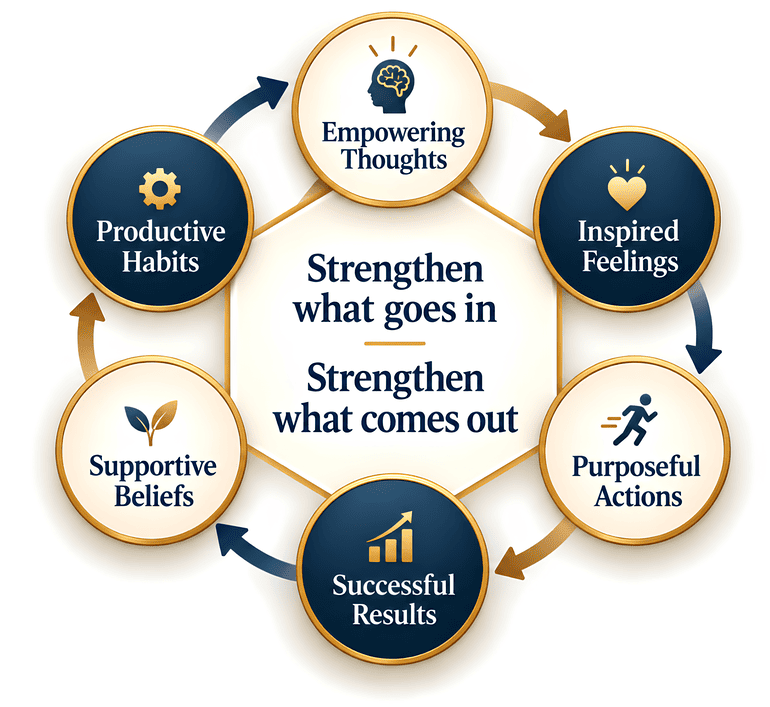
An empowering thought creates a
stronger feeling. That feeling leads to an action you might
once have avoided. The action produces a result, and the
result gives you new evidence about yourself: I can do
this. That evidence strengthens your beliefs, your
beliefs become habits, and your habits shape the next
thought. Then the cycle comes around again, a little higher
each time.
That’s why the change doesn’t stay small:
•
When you’re more confident, you attempt more.
•
When you attempt more, you gain more experience.
•
When you recover faster from mistakes, you learn more from
them.
•
When you think bigger, you spot opportunities you used to
walk right past.
Each win becomes the starting point
for the next one.
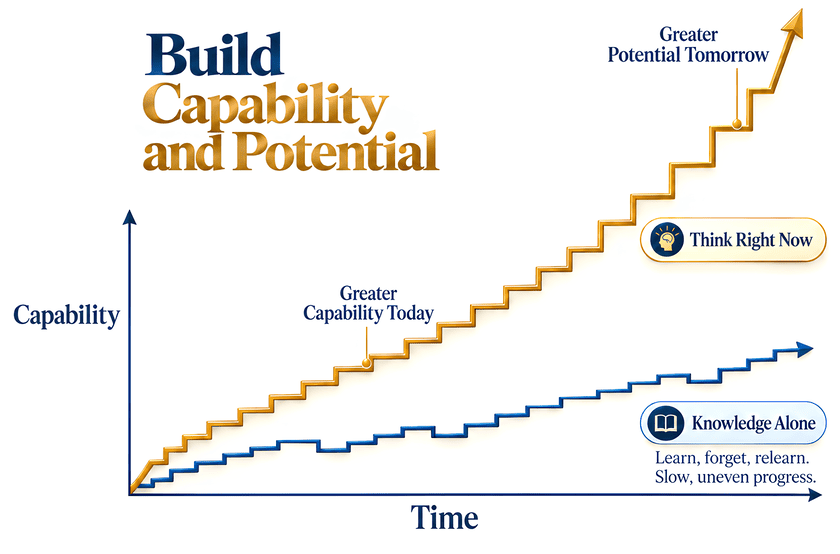
Knowledge alone builds your ability
slowly.
Knowledge plus the empowered thinking
to use it builds on itself, and the difference keeps
widening.
Not all at once, and not by magic.
But thought by
thought, action by action, result by result.
|
Change Your Life
Without Giving Up a Minute of Your Day |
 Most
ways of changing yourself hand you one
more thing to do. Most
ways of changing yourself hand you one
more thing to do.
Read this.
Study that.
Fill out the workbook.
Practice for 30 minutes a day.
Think Right Now works differently.
Put in a single earbud, press play, and let the program
quietly whisper in your ear while you work, drive, exercise,
clean the house, answer email, or watch TV. You don’t have
to stop your life to change it.
The Easiest Time of All: While You Sleep
 Every night, you spend hours when you couldn’t possibly be
doing anything else. Play your program softly as you fall
asleep, quietly enough that it never disturbs your rest, and
those hours start working for you. Every night, you spend hours when you couldn’t possibly be
doing anything else. Play your program softly as you fall
asleep, quietly enough that it never disturbs your rest, and
those hours start working for you.
Falling asleep is an ideal time to listen. As you drift off,
your brain slows into theta, the same rhythm that's
prominent in young children's brains during the years they
absorb so much of what they come to believe. And research
shows the brain keeps learning in light sleep. In one study,
smokers conditioned while asleep smoked about 30% less the
following week.
It takes nothing from your day. No
schedule to keep, nothing to remember, nothing to
give up. You press play, go to sleep, and wake up another
step closer to the person you want to be.
Then you start catching yourself being
different. Something happens that used to set off the same
old reaction, and it doesn’t. You do something you used to
have to talk yourself into. You make a hard decision without
going back and forth about it 40 times. You handle a tough
situation and realize afterward, Wow. That was easy.
|
Ashleigh Zimmerman
couldn’t pick up the phone to call her clients
“without staring at it for ten minutes.” She put
her program on while she slept: “It’s easy to
fit in to my schedule because I just simply
listen to it while I sleep.” Now she wakes
up “knowing that today is another day to win”
and goes out to meet new clients “without
shaking in my shoes.”
Sarju
in London had saved almost nothing in his life.
In his first week of listening through the
night, he woke up with a plan to save about £100
a month and the motivation to open a savings
account. He called it “a minor miracle,”
especially “the fact that this transformation
occurred in my sleep.” |
No extra hours. No homework. Just the life you’re already
living, getting better.
|
|
|
|
|
No Credit Card Required
Put Think Right
Now to use during things you already do. |
|
From Living in a Van
to the #1 Sales Rep in the World |
I’m Mike Brescia,
the founder of Think Right Now. I never planned to start a
personal-development company. I was just trying to fix my
own life.
In 1987, I was working in commission-only sales and failing
badly. I had read the books. I understood the trainers. I
knew what successful salespeople said and did. But when I
picked up the phone and heard the same questions they
handled with ease, I froze.
I knew what to do. I just couldn’t get myself to do it.
I’d slept on friends’ couches and floors and lived in a van.
Now I was back at my parents’ house because I couldn’t
support myself. I had no career, no skill anyone would pay
much for, and almost no hope left.
I didn’t need another book telling me what to do. I needed
to become someone who could actually do it.
The Book That Changed Everything
Then I found a book called Superlearning. It
described the work of Dr. Georgi Lozanov, whose
accelerated-learning students were reported to learn up to
1,000 foreign-language words in a single day and remember
about 97 percent of them.
That stopped me cold. If this method could help someone
learn a new language, could I use it to learn a new way of
thinking? Could I condition myself to think, feel, speak,
and act like the best salespeople in the world?
I was desperate enough to find out.
I wrote hundreds of affirmations describing the thoughts,
beliefs, and responses I believed a top salesperson would
have. Every time I spotted a fear, expectation, or habit
that was hurting me, I wrote statements to replace it. Then,
with some pretty basic equipment, I recorded them over
Baroque music using the accelerated-learning structure I’d
read about. I listened while I worked, drove, and slept.
Basically 24/7.
And I began to change. I stopped dreading the
phone. I stopped avoiding the work. I became more confident,
disciplined, and persistent, and I finally started using
what I already knew.
The information hadn’t changed. I had.
What Happened Next
The results were more than I could have imagined while
living in a van. My efforts helped build the largest
coin-operated television business in the country. I became
the number-one sales representative in the world for
Siemens, the world’s largest hearing-aid manufacturer. Then
I became the top representative in North America for Books
Are Fun, a company doing nearly $400 million a year.
After a decade of those results, I
started asking a bigger question: If changing the way I
thought could do this for my sales career, what else could
it do? Could it help people build confidence? Could it
change the patterns behind procrastination, low
self-esteem, anxiety, and depression?
 Those
questions became Think Right Now. ThinkRightNow.com launched
in 2001 and grew to include dozens of audio programs and
Think Right Now for Windows. At its peak, Alexa ranked it
9,934 in the world, among the 10,000 most visited websites
of any kind. Those
questions became Think Right Now. ThinkRightNow.com launched
in 2001 and grew to include dozens of audio programs and
Think Right Now for Windows. At its peak, Alexa ranked it
9,934 in the world, among the 10,000 most visited websites
of any kind.
Rebuilt From the Ground Up
Today, I’m rebuilding Think Right Now from the ground up.
Every program is far more comprehensive, every statement is
written with
far greater precision, and every
program now includes ThinkTrak, so you can measure your
change from Day 1 to Day 30 and beyond. The recording process
has come a long way since 1987, too.

But the discovery behind it hasn’t
changed. You can know exactly what to do and still have
thoughts, fears, and habits that keep you from doing it.
Change those, and everything you know starts working for
you.
That’s what happened to me.
Want proof in your
own life?
Choose your free Foundation, follow the
Quick-Start Guide, and find out what changes for you—free,
with no obligation.
|
You
Already Use Affirmations
All
Day |
Say “affirmations” and many people
picture someone at a mirror repeating, “I’m wonderful.
Everybody loves me.” It’s easy to dismiss.
 But
listen to your own inner voice for a day. But
listen to your own inner voice for a day.
It asks questions:
“What if this doesn’t work?”
It gives orders:
“Don’t screw this up.”
And, more than anything, it makes statements about what it
believes is true.
Those statements are affirmations:
“I’m exhausted.” “I handled that pretty well.” “Something
always goes wrong.” “I could learn to do that.” “There’s no
way I can afford that.” “This is going to be a great day.”
You see? You don’t use affirmations once in a while...
You think in them all day long, mostly without ever
noticing. And they don’t just describe your life.
Repeat the same ones often enough, and they steer it.
Picture yourself at breakfast...
Your mind starts:
“I’m already behind. I’ll never get everything done
today. Why does every day have to be like this?”
One
thought leads to the next, and five minutes later you’ve
built a whole case for why your life is a mess. You feel far
worse than when you sat down.
Now picture the same breakfast with different thoughts:
“Today is going to be a great day. I can handle anything
that comes up. I’m going to make something good happen.”
Same morning. Same to-do list.
But your attention, your mood, and what you do next all head
somewhere completely different.
So the real question isn’t whether you use affirmations.
You do... All. Day. Long.
The question is what yours have been teaching you
to believe about yourself, and where they’ve been steering
your life.
Think Right Now takes that constant inner conversation and
puts it to work on purpose. Each program replaces the
statements that have been holding you back with precisely
targeted ones that build the beliefs, expectations, and
automatic responses you want.
Give yourself
thoughts worth repeating.
|
Programs Built to Take You
as Far as You Can Go |
Many affirmation recordings try to
cover confidence, money, health, motivation, and
relationships all at once.
Think Right Now programs don’t.
Each one focuses on a single area of your life and stays
with it, because every topic is far more involved than it
looks.
Take self-esteem. “I love myself.” “I am worthy.” “I am
enough.”
Those are good beliefs to have. But real
self-esteem shapes what you tell yourself after a mistake,
how you react when someone criticizes you, what treatment
you accept from other people, whether you trust your own
judgment, what you believe you deserve, and so much more.
A handful of very basic statements can’t reach all of that.
So every program starts with a much higher standard. It
looks at the people who get extraordinary results in that
area of life: what they believe, what they expect, how they
think, and how they respond when things go wrong. Then
it's built to that standard: the highest level possible in
that area of your life.
|
|
|
Clear the Road,
Then Build the Bridge |
|
|
Before a single statement is
constructed, each subject is taken apart in two directions:
what’s working against the change you want, and what needs
to be built in its place.
Take Supreme Confidence Now. Low confidence is
rarely one thought that says, “I’m not confident.”
It’s fear of being judged, constant second-guessing, needing
reassurance, comparing yourself with others, expecting
embarrassment, treating mistakes as proof you’re not
capable, and staying quiet when you have something valuable
to say.
Repeating
“I am confident”
a thousand times can’t touch all of that.
Then comes the other direction: what strong, healthy
confidence actually requires. Trusting your own judgment.
Speaking clearly. Making decisions without knowing exactly
how things will turn out. Handling criticism. Recovering
from mistakes. Feeling equal to other people. Taking action
even when you’re nervous.
By the time the research on one
subject is finished, it has often identified more than
1,000, sometimes more than 1,500, thoughts, beliefs,
emotions, expectations, reactions, and habits that affect
the result.
That map produces two different kinds of statements:
•
Clearing statements
break down the fears, limiting beliefs, and old reactions
that keep the problem going.
•
Installing statements
build the thoughts, feelings, and responses that take their
place.
In many programs, 35% to 45% of the
statements are clearing statements. That’s deliberate. You
can’t build real confidence by laying positive words on top
of the same fears that keep tearing it down.
Every Statement Has a
Specific Job
Once the map is complete, every statement is designed
because the map revealed a particular piece of work that
needs doing.
Here are three from Supreme Confidence Now:
•
“After every mistake, I forgive myself, learn from it, and
keep going.”
Its job: stop one mistake from becoming a verdict about who
you are.
•
“I turn fear into fuel for focused, courageous action.”
Its job: change what happens next when fear shows up, so it
becomes a reason to act instead of retreat.
•
“I can always be counted on to take care of what matters.”
Its job: build the confidence that comes from knowing you
can depend on yourself.
That’s why a Complete Program’s 136 to
more than 200 statements aren’t 200 ways of saying “I am
confident.”
They’re precision parts, each doing
its own job.
Together, they add up to a new way of
thinking, feeling, and responding that starts showing
up naturally.
Choose your free Foundation
for the change that matters most to you.
|
How New
Thinking Becomes
Automatic |
Remember the students who learned up
to 1,000 foreign-language words in a single day? Each new
word simply matched one they already knew. Chien
means dog. Nothing inside them pushed back. There was no
fear attached to it, no painful memory, no reason to resist.
But changing an emotionally charged habitual thought or belief you’ve repeated for
10,
20, or 30 years is a very different
job. Many limiting thoughts started out as protection. Your
mind serves up vivid pictures of what could happen if you
take the risk, speak up, or open your heart: you could fail,
look foolish, or get hurt.
“Don’t get too close. It always ends badly.”
A thought like that isn’t neutral. It believes it’s keeping
you safe, so it pushes back against anything that tries to
replace it.
Repetition makes protection automatic.
Imagine someone walked up and slapped you in the face every
morning for 30 days. By day 31, your hand would fly up the
moment you saw them, before you had a single thought.
Nobody taught you that. Conditioning through repetition did.
Limiting thoughts form the same way.
You may have thought “I’ll never get ahead” or
“Something is bound to go wrong” thousands of times, and
every repetition made it stronger. It started as a thread.
Repetition turned it into a string, then a rope, and
eventually a braided steel cable.
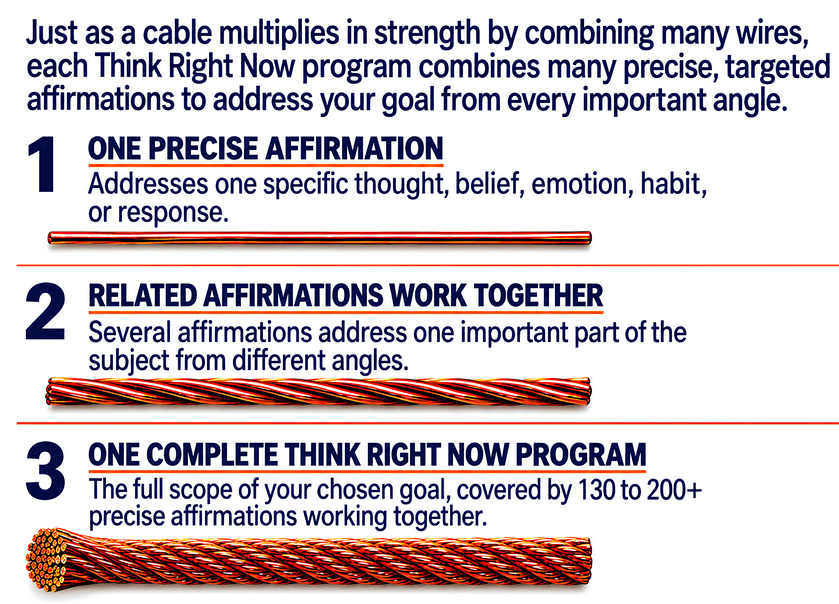
A few positive words spoken a few times can’t compete with
that cable, especially one your mind believes is protecting
you.
The new response needs the same thing the old one had:
repetition.
That’s why Think Right Now uses Accelerated Neuro
Conditioning.
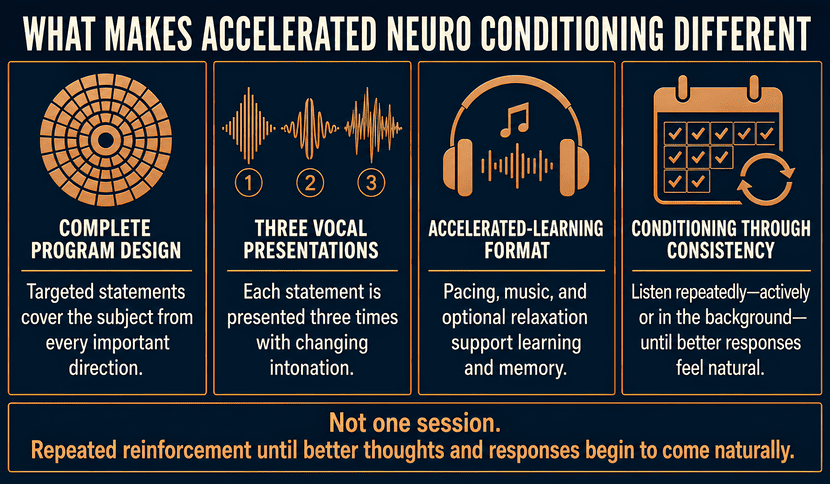
•
Three presentations of every statement.
Each one is spoken three times, in three different vocal
presentations, so you hear every idea three ways instead of
as one flat repetition.
•
Deliberate pacing.
Each statement has time to register before the next one
begins.
•
Specially composed music.
A slow, steady 60 beats per minute helps create the relaxed,
alert state used in accelerated learning, a state associated
with alpha brain activity.
•
An optional relaxation induction.
When you want to give the program your full attention, it
guides you into a calm, focused state so you can concentrate
completely.
Then you listen again. And again. There’s nothing to
memorize, rehearse, or practice.
Ready Before the Moment Arrives
Here’s why that matters. The situations that trigger your
old conditioned patterns may only come once in a while. You
may not face criticism today, or a difficult decision, or an
opportunity that tests your confidence.
But you can hear the new thoughts and responses today. And
tomorrow. And the day after that.
So when the real moment finally comes, the old way of
thinking is no longer the only message you’ve heard again
and again.
The new one is ready, and it’s the one that shows
up.
Hear it for
yourself.
Choose your free Foundation and listen to your
first full-length volume today.
|
You Won't
Have to Remind Yourself |
The goal isn’t to spend your life reminding yourself to be
confident, calm, happy or motivated. It’s to simply be
that way, so the thoughts that serve you best are the ones
that show up first.
Here’s what that looks like with one program, Think Big
Now.
So, an
idea comes to you.
In the past, it would have ended right there:
“That’s probably not realistic.”
Now it keeps growing:
“What if this could be much bigger? Who else could benefit
from it? Where could this lead five or ten years from now?”
Then a big opportunity appears. The old you would have
thought:
“That’s too big for me. I couldn’t do that. What if I fail?”
Now your mind goes somewhere completely different:
“This could be extraordinary. What would make it even
better? Who could help me take it further? What’s my first
move?”
You don’t stop and recite those words. You don’t have to
remember what the program said. This is simply how you
think now. You see possibilities you would have missed,
you take ideas further, and you act on opportunities you
once would have dismissed.
Every Think Right Now program is built to do the same thing
in its own area:
make the thinking you want your natural, automatic response.
Imagine what that
change would make possible in your life.
Choose your free Foundation and start putting
it to use today.
Eight Ways To Use Your Program.
Pick the Ones That Fit
There’s no single right way to listen, and nothing you have
to do every day. Start with whichever method fits your life.
When you want faster, deeper change, add another.
Just
Press Play
 1 —
Let it
play in the background. 1 —
Let it
play in the background.
Play your program quietly through room or car speakers while
you work, drive, cook, or clean. You don’t have to listen
closely. It simply plays while you get on with your day.
During your commute, your chores, or a quiet afternoon at
your desk, your mind usually runs on autopilot, replaying
the same worries and doubts it always has. With your Think
Right Now program playing, those hours go to work for you
instead, reinforcing the confidence, calm, or motivation you
want to build.
 2 —
Let it whisper in one ear. 2 —
Let it whisper in one ear.
Put in one earbud, turn the volume down to a whisper, and
keep working, walking, exercising, talking with people, or
running errands. Your other ear stays free for everything
around you.
Because it's discreet and leaves you free to talk and hear
what's around you, you can listen for hours during the
busiest parts of your day, even where speakers aren't an
option. More listening means more repetition, and repetition
is what makes the new thinking your own.
 3 — Let It Whisper While You Sleep 3 — Let It Whisper While You Sleep
Play your program softly enough that it never disturbs your
rest. If you listened on purpose, you could make out the
words. Otherwise, they stay a quiet whisper in the
background. Start it as you drift off, when your brain slows
into theta, an ideal time to listen.
Sleep gives you hours every night that you couldn't possibly
use for anything else. Now those hours add repetition to
your program night after night, without taking a single
minute from your day.
 4 — Give it your full attention 4 — Give it your full attention
Set aside about 30 minutes, get comfortable somewhere quiet,
close your eyes, and begin with the relaxation induction
included in the Complete Programs.
The induction guides you into a deeply relaxed, focused
state, so your mind is calm, open, and ready to take in
every statement.
This is the most concentrated way to listen. With nothing
competing for your attention, every statement gets your
complete focus, and you go straight at the limitation you
want out of your life.
Never use the relaxation induction while driving or doing
anything that needs your attention.
Go Further Whenever You Want
 5 —
See the statements on your screen. 5 —
See the statements on your screen.
Paste
the statements from your program’s script into Think Right
Now for Windows. Choose how often they flash and how long
each one stays on screen, and they’ll appear at random spots
on your screen while you work.
If you spend hours a day at a computer, those hours now
reinforce the same thoughts your program is building,
through your eyes as well as your ears. You don't have to
stop working or even think about it. The statements simply
keep showing up.
 6 — Read the
statements 6 — Read the
statements
Print your program’s script and go through it at your own
pace. Mark the statements that hit you hardest, the ones
that describe exactly what you want to change.
Reading lets you see precisely what your program is working
on. You can stay with a single statement, think about what
it means, and picture how your life will look when it's
completely true for you. And when those new thoughts start
showing up in your own mind, you'll recognize them.
 7 — Say your favorites out loud 7 — Say your favorites out loud
When a statement describes something you deeply want to
believe, feel, or do, say it out loud in your own voice.
Hearing the words in your own voice makes them feel more
personal. It's no longer just someone on a recording saying
them. It's you, declaring them, and that turns listening
into your own active decision to change.
 8 — Write some down 8 — Write some down
Choose some statements that answer your biggest fears,
limitations, or habits, and write them out by hand. Write
them as many times as you like.
Writing forces you to slow down and give those changes your
complete attention. When there are a few deeply rooted
thoughts you’re determined to replace, this is one of the
most direct ways to go after them.
Most people start with one or two methods and add more as
they see results. However you use your program, the more
often you hear the new thoughts, the faster they become your
own.
Choose your free Foundation,
open the Quick-Start Guide, and start with the listening
method that fits your life.

|
When You Become More,
You Have More
To Give |
Think Right Now programs aren’t designed just to make you
feel good while you’re listening.
The real payoff shows up while you’re living your life.
Something happens that once would have thrown you off, and
you handle it calmly. An opportunity appears, and instead of
listing all the reasons it won’t work, your mind starts
looking for ways to make it happen. You’re in the middle of
an ordinary day and suddenly notice how much there is to
enjoy.
And those changes don’t stay in one corner of your life. You
bring more confidence to what you attempt, more persistence
to what you practice, more resilience to setbacks, and more
belief in yourself to whatever matters to you.
The people around you feel it too.
Your family gets a more patient, more present you. The
people you work with get your best ideas instead of your
second-guessing. Your friends, customers, and community get
more of who you really are. When you become more, you have
more to give.
That’s what all the research, the mapping, the precisely
targeted statements, and the repetition are ultimately for.
Not simply to hear positive thoughts, but to become someone
who lives them, and to carry that stronger version of
yourself into whatever you decide to do next.
Take the Change Further
With the Complete Programs
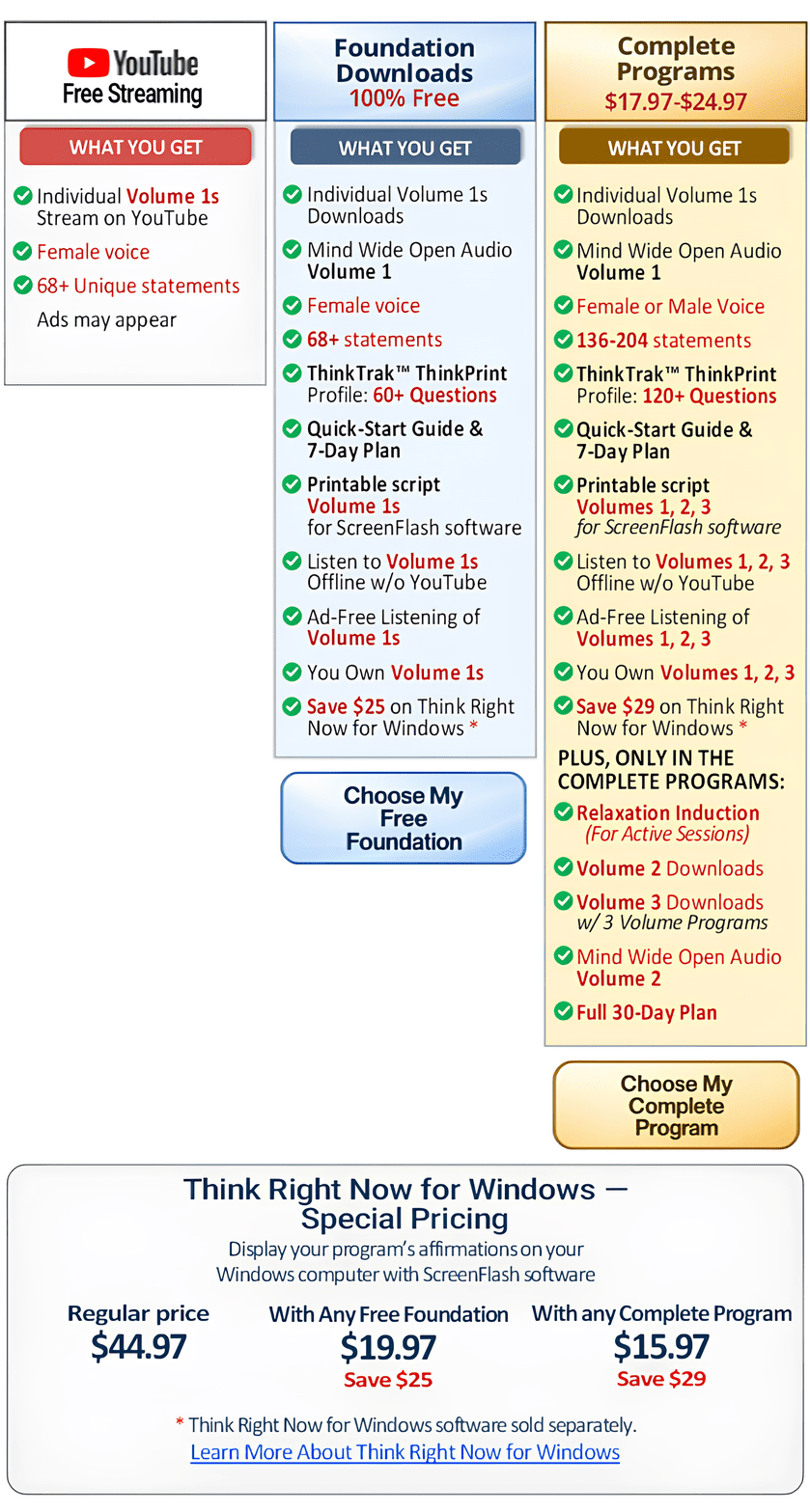
Your free Foundations start the change. The Complete
Programs are built to finish it, reaching every belief,
fear, expectation, and habit in that area of your life,
not just the first layer.
Here’s what that means for you:
•
They reach every part of the problem.
Two or three full volumes with 136 to more than 200
precisely targeted statements, compared with the
Foundation’s 68-plus. Every major area the research mapped
gets addressed, so no old pattern is left untouched to pull
you back.
•
They show you the full picture.
Your Foundation ThinkPrints are like X-rays. The Complete
ThinkPrints, each with 120-plus questions, are more like
MRIs. They pinpoint exactly which patterns are holding you
back, how strongly, and how much each one has changed by Day
30 and beyond.
•
They give you your deepest listening sessions.
The relaxation induction guides you into a deeply relaxed,
focused state, so you can give the program your complete
attention whenever you want to go straight at the problem.
•
It walks you through all 30 days.
The 30-Day Plan picks up where the 7-Day Foundation Plan
leaves off, so you always know what to do next, right up to
your Day 30 measurement.
•
They fit the way you listen.
Choose a female or male voice, and get the printable
scripts for every volume to read, mark, and use with Think
Right Now for Windows.
•
They complete your preparation.
Mind Wide Open Now, Volume 2, continues opening your mind to
learning, growth, and everything ahead of you.
•
Save the most on Think Right Now for Windows.
Complete Program owners get it for $15.97, a $29 savings.
Whatever you want to change, you already know what staying
the same has cost you: the opportunities you let pass, the
goals you kept putting off, the years of settling for less
than you're capable of. A Complete Program is $17.97 to
$24.97, about the price of one hardcover book. But a book
gives you more to know. A Complete Think Right Now Program
changes the person who reads it.
There’s no shipping and no waiting. Download your Complete
Program immediately, follow your 30-Day Plan, and you’re
protected by a 30-day money-back guarantee.
| |
|
Start free with any free Foundations, or go
straight to the Complete Programs and take the
change as far as it can go. |
|
Experience Think Right Now Free—and
Measure What Changes |
You’ve seen how Think Right Now programs are built, how they
work, and what they’re designed to change. Now choose the
area of your life that matters most, and start today.
Every Think Right
Now program has its own free Foundation. Whichever
Foundation you choose, you get:
 |
Your ThinkPrint,
built for that program, to show you what’s really
been holding you back. |
 |
Your Quick-Start Guide and 7-Day Foundation Plan,
so you know exactly what to do from day one. |
|
|
The complete 30-plus-minute Volume 1,
identical to the one in the Complete Program. |
 |
The printable Volume 1 script,
ready for reading or for Think Right Now for
Windows. |
 |
Mind Wide Open Now, Volume 1,
to open your mind to learning, growth, and
everything ahead. |
 |
A Foundation Member discount
on Think Right Now for Windows. |
| |
Plus, ad-free
listening, online or offline. |
| |
|
No Catch
No credit card. This isn’t a trial, and nothing bills you
after 30 days. Each Foundation is yours to keep and use for
as long as you like.
The 30 days are simply your measurement period. Take your
ThinkTrak
assessment on Day 1, use your program, take it again on Day
30, and see exactly what changed.
Why Give This Much Away?
Each Think Right Now program's Volume 1 audio (and much more!) is given away for
free because Think Right Now exists to help people change,
grow and thrive. Every Volume 1 that we give away is another person’s
chance to become stronger, happier, more confident, and more
capable, or to make whatever change brought them here.
And when one person’s life gets better, it rarely stops with
them. It reaches their families, their friends, their work,
and their communities.
Every time one person changes their own world for the
better, the world itself changes with them.

|